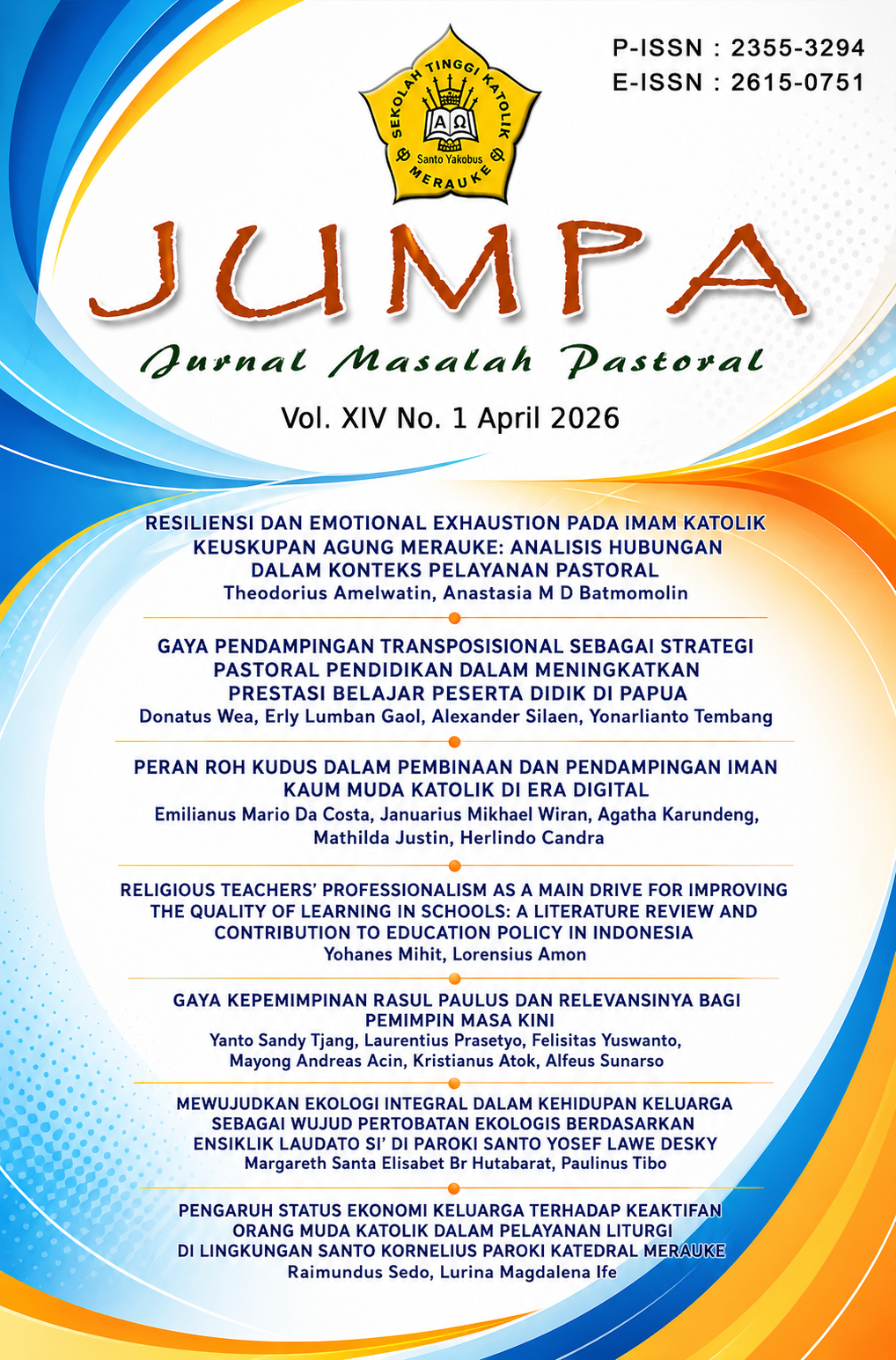
GAYA PENDAMPINGAN TRANSPOSISIONAL SEBAGAI STRATEGI PASTORAL PENDIDIKAN DALAM MENINGKATKAN PRESTASI BELAJAR PESERTA DIDIK DI PAPUA
DOI:
https://doi.org/10.60011/jumpa.v14i1.331Kata Kunci:
Pendampingan Transposisional, Prestasi Belajar, Pembelajaran Kontekstual, PastoralAbstrak
Penelitian ini dilatarbelakangi oleh rendahnya prestasi belajar peserta didik di Papua yang disebabkan oleh kesenjangan antara pendekatan pendidikan nasional dan konteks sosial-budaya lokal. Oleh karena itu, penelitian ini bertujuan untuk: mengidentifikasi bentuk implementasi pendampingan transposisional di sekolah-sekolah Katolik di Papua; menganalisis faktor-faktor yang mendukung dan menghambat penerapannya; serta menguji pengaruh pendampingan transposisional terhadap peningkatan prestasi belajar peserta didik. Penelitian ini menggunakan pendekatan mixed methods, dengan desain kualitatif deskriptif dan kuantitatif quasi-eksperimental. Data kualitatif diperoleh melalui wawancara mendalam, observasi partisipatif, dan focus group discussion pada lima sekolah Katolik di Papua Selatan, Papua Pegunungan, dan Papua Tengah dengan total 85 informan. Data kuantitatif diperoleh melalui desain Nonequivalent Control Group pada 150 peserta didik di SMP Katolik Santo Mikhael Merauke yang dibagi menjadi kelompok eksperimen dan kontrol. Analisis data dilakukan menggunakan model interaktif serta uji statistik deskriptif dan inferensial. Hasil penelitian menunjukkan bahwa pendampingan transposisional telah diimplementasikan secara praksis melalui kontekstualisasi materi ajar, penggunaan bahasa dan budaya lokal, pendampingan relasional, pembelajaran berbasis pengalaman, refleksi kritis, serta adaptasi kurikulum. Faktor pendukung utama meliputi komitmen pedagogis guru, kedekatan kultural, budaya relasional, dukungan institusi, dan keterlibatan komunitas, sedangkan faktor penghambat meliputi keterbatasan pemahaman konseptual, tekanan administratif, keterbatasan sarana, jarak budaya, dan rendahnya motivasi belajar. Secara kuantitatif, pendampingan transposisional terbukti meningkatkan prestasi belajar secara signifikan. Dengan demikian, pendampingan transposisional merupakan strategi pembelajaran yang efektif, kontekstual, dan transformatif dalam meningkatkan prestasi belajar peserta didik di Papua. Pendekatan ini perlu diintegrasikan secara sistematis dalam kebijakan pendidikan dan pengembangan profesional guru.
Referensi
Banks, J. A. (2016). Cultural diversity and education: Foundations, curriculum, and teaching (6th ed.). New York, NY: Routledge.
Bass, B. M., & Riggio, R. E. (2006). Transformational leadership (2nd ed.). Mahwah, NJ: Lawrence Erlbaum Associates.
Brookfield, S. D. (2017). Becoming a critically reflective teacher (2nd ed.). Jossey-Bass.
Brunzell, T., Waters, L., & Stokes, H. (2016). Teaching with strengths in trauma-affected students: A new approach to healing and growth in the classroom. American Journal of Orthopsychiatry, 86(1), 3–9. https://doi.org/10.1037/ort0000138
Caldwell, B. J., & Spinks, J. M. (2013). The self-transforming school. London: Routledge.
Chevallard, Y. (1985, 1991, 1992). La Transposition Didactique. Grenoble: La Pensée Sauvage.
Darmawan, J., & Sitorus, M. (2020). Kontekstualisasi pendidikan dalam budaya lokal Indonesia Timur. Jurnal Pendidikan dan Kebudayaan, 25(2), 143–158.
Deci, E. L., & Ryan, R. M. (2000). The “what” and “why” of goal pursuits: Human needs and the self-determination of behavior. Psychological Inquiry, 11(4), 227–268. https://doi.org/10.1207/S15327965PLI1104_01
Dewey, J. (1933). How we think: A restatement of the relation of reflective thinking to the educative process. Boston, MA: D.C. Heath.
Epstein, J. L. (2011). School, family, and community partnerships: Preparing educators and improving schools (2nd ed.). Boulder, CO: Westview Press.
Freire, P. (1970). Pedagogy of the oppressed. New York, NY: Continuum.
Freire, P. (2018). Pedagogy of hope: Reliving pedagogy of the oppressed. Bloomsbury.
Fullan, M., Quinn, J., & McEachen, J. (2018). Deep learning: Engage the world change the world. Thousand Oaks, CA: Corwin.
Gay, G. (2010). Culturally responsive teaching: Theory, research, and practice (2nd ed.). New York, NY: Teachers College Press.
Greenleaf, R. K. (1977). Servant leadership: A journey into the nature of legitimate power and greatness. New York, NY: Paulist Press.
Hargreaves, A., & Fullan, M. (2012). Professional capital: Transforming teaching in every school. New York, NY: Teachers College Press.
Johnson, D. W., & Johnson, R. T. (2014). Cooperative learning in 21st century. Anales de Psicología, 30(3), 841–851.
Johnson, E. B. (2019). Contextual teaching and learning: What it is and why it’s here to stay. Corwin Press.
Kambuaya, Y. (2021). Pendidikan kontekstual berbasis budaya lokal di Papua. Jurnal Pendidikan dan Kebudayaan Papua, 5(2), 101–115.
Kementerian Pendidikan dan Kebudayaan. (2021). Indeks Kualitas Pendidikan Daerah Tertinggal di Indonesia. Jakarta: Balitbang Kemendikbud.
Kemendikbudristek. (2022). Profil Pendidikan Wilayah Papua. Jakarta: Pusat Data dan Informasi Pendidikan.
Kolb, D. A. (1984). Experiential learning: Experience as the source of learning and development. Englewood Cliffs, NJ: Prentice Hall.
Kongregasi untuk Pendidikan Katolik. (1977). Sekolah Katolik. Vatikan: Libreria Editrice Vaticana.
Konsili Vatikan II. (1965). Gravissimum Educationis: Pernyataan tentang Pendidikan Kristen. Vatikan: Libreria Editrice Vaticana.
Konsili Vatikan II. (1965). Gaudium et Spes: Konstitusi Pastoral tentang Gereja di Dunia Modern. Vatikan: Libreria Editrice Vaticana.
Ladson-Billings, G. (1995). Toward a theory of culturally relevant pedagogy. American Educational Research Journal, 32(3), 465–491.
Lumbantobing, F. (2018). Pendidikan kontekstual dan tantangan globalisasi di Indonesia Timur. Jurnal Ilmu Pendidikan, 17(3), 211–226.
Mandacan, Y. (2023). Refleksi pendidikan multikultural di Papua: antara idealisme dan realitas lapangan. Papua Education Journal, 5(1), 45–60.
Maslow, A. H. (1954). Motivation and personality. New York, NY: Harper & Row.
Mezirow, J. (2018). Transformative Learning Theory: A critical review. New York: Routledge.
Miles, M. B., Huberman, A. M., & Saldaña, J. (2019). Qualitative data analysis: A methods sourcebook (4th ed.). Sage.
Mofu, M. (2019). Pendidikan berbasis konteks budaya Papua: Tantangan dan peluang. Jurnal Ilmu Pendidikan, 25(1), 55–68.
Mofu, A. (2021). Pendidikan kontekstual di Tanah Papua: peluang dan tantangan implementasi Kurikulum Merdeka. Jurnal Pendidikan Indonesia, 9(4), 311–328.
Nababan, D., & Siregar, H. (2022). Pendampingan partisipatif dan dampaknya terhadap motivasi belajar siswa. Jurnal Pedagogik, 14(1), 57–70.
Paus Fransiskus. (2013). Evangelii Gaudium: Seruan Apostolik tentang Pewartaan Injil di Dunia Dewasa Ini. Vatikan: Libreria Editrice Vaticana.
Paus Fransiskus. (2020). Fratelli Tutti: Ensiklik tentang Persaudaraan dan Persahabatan Sosial. Vatikan: Libreria Editrice Vaticana.
Paus Fransiskus. (2024). Spes Non Confundit: Bulla Penetapan Yubileum Biasa Tahun 2025. Vatikan: Libreria Editrice Vaticana.
Piaget, J. (1970). Science of education and the psychology of the child. New York, NY: Viking Press.
Rante, Y. (2020). Strategi pendidikan kontekstual di daerah 3T: Sebuah pendekatan transformatif. Jurnal Inovasi Pendidikan, 8(2), 89–103.
Rogers, C. R. (1969). Freedom to learn. Columbus, OH: Merrill.
Rumbiak, M. (2021). Kearifan lokal dalam peningkatan prestasi belajar siswa Papua. Jurnal Pendidikan Papua, 4(2), 98–115.
Sagala, S. (2019). Manajemen pembelajaran dan makna transposisi pedagogis. Bandung: Alfabeta.
Sergiovanni, T. J. (1992). Moral leadership: Getting to the heart of school improvement. San Francisco, CA: Jossey-Bass.
Suharno, P. (2020). Transformasi pedagogis dan pendampingan reflektif dalam pendidikan kontekstual. Jurnal Filsafat Pendidikan, 12(1), 33–49.
Suryani, D., & Mulyana, R. (2020). Pendekatan humanistik dalam pembelajaran: Upaya peningkatan prestasi belajar siswa. Jurnal Pendidikan Humaniora, 8(2), 77–89.
Titus, L. (2020). Transpositional mentoring: A transformative approach to contextual learning. Journal of Educational Transformation, 12(3), 221–235.
Trilling, B., & Fadel, C. (2009). 21st century skills: Learning for life in our times. San Francisco, CA: Jossey-Bass.
Verret, M. (1975). Le temps des études. Paris: Libraire Honoré Champion.
Vygotsky, L. S. (1978). Mind in society: The development of higher psychological processes. Cambridge, MA: Harvard University Press.
Wambrauw, Y., & Kambu, M. (2022). Pendidikan kontekstual dan budaya belajar siswa Papua. Papua Education Review, 4(1), 44–60.
Wanggai, R. (2023). Pendidikan dialogis dalam konteks Papua: refleksi atas praksis belajar yang membebaskan. Jurnal Humaniora Papua, 6(1), 70–85.
Wonda, E., & Kambu, J. (2019). Model pembelajaran berbasis budaya lokal dalam meningkatkan hasil belajar siswa Papua. Jurnal Pendidikan Nusantara, 7(1), 102–118.
Unduhan
Diterbitkan
Cara Mengutip
Terbitan
Bagian
Lisensi
Hak Cipta (c) 2026 donatus wea, Erly Lumban Gaol, Alexander Silaen, Yonarlianto Tembang

Artikel ini berlisensi Creative Commons Attribution-NonCommercial-NoDerivatives 4.0 International License.